

Explainer
Brand ownership vs. political funding: two different questions
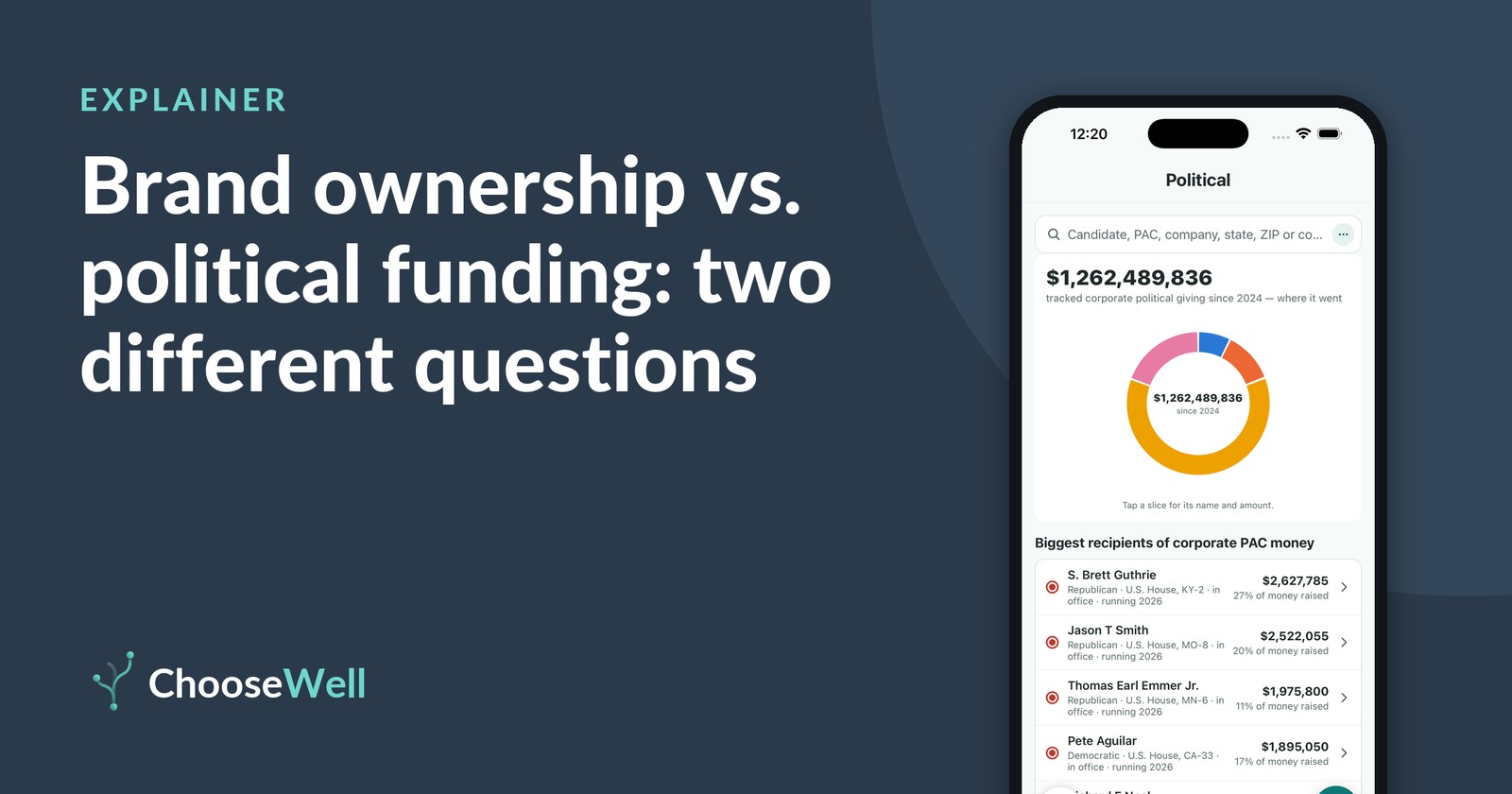
Two questions often get blended together when people talk about "who's behind" a product: who owns the brand, and what that company does with its money in politics. They come from different public records and answer different questions, which is why ChooseWell shows both, side by side, and keeps them separate.
Brand ownership: who makes it, and who profits
Ownership is about the corporate structure behind a product: which company owns the brand, and whether that company belongs to a larger parent. A shelf of "competing" shampoos, cereals or cleaners is sometimes made by a handful of corporations. A bottle of Dawn dish soap, for example, belongs to Procter & Gamble.
This information comes from company filings with the SEC's EDGAR database, federal registrations at SAM.gov and the public Wikidata knowledge base. ChooseWell uses it to show the maker at the top of a product page, with the parent company beneath it.
Political funding: where the company's money goes
Political funding is about what a company spends to influence government: its corporate PAC's contributions to candidates, its federal lobbying, money from its treasury to Super PACs, and state-level giving. It's disclosed separately, in FEC filings, quarterly lobbying reports and state campaign-finance records.
Why the two aren't interchangeable
Ownership tells you who benefits financially when you buy a product. Political funding tells you what that company has chosen to support. A large, well-known company can report very little political spending, and a smaller one can report a lot. Reading one as a stand-in for the other can lead to the wrong conclusion in either direction.
There's also a rule of thumb for where the money belongs: political spending is recorded against the company that owns the brand. That's why a product page links the brand to its parent first, and only then shows the spending.
How to use both together
- Scan the product and read the maker and parent company at the top of the page.
- Open the Political score to see that company's spending since 2024, the party split of its PAC giving, and its lobbying.
- To look at it from the other side, the Political section (part of ChooseWell Pro, switched on in Priorities) lets you search a candidate or PAC and see which companies' money appears there.
What this means, and what it doesn't
Neither record is a verdict. ChooseWell shows the ownership chain and the disclosed spending as separate facts with their sources. The overall Good, Okay or Poor rating on a product page is a plain average of the scores you keep switched on, and you can switch the Political score off in Priorities if you'd rather leave it out. Personal donations by individual employees aren't counted, because that's their own money, not the company's. For what each kind of spending means, see How to read a company's political spending.
How ChooseWell shows this
The maker and parent company sit at the top of each product page; the Political score below lists the spending and every filing behind it.
Check it yourself
Scan any barcode in ChooseWell to see the maker's open recalls, flagged ingredients and political spending, each with its public source. Free to scan, no account.