

Explainer
How to spot outdated or misleading claims on a package
Front-of-package words are written to catch your eye, and some carry far less weight than they seem to. A few have strict legal meanings, some have none, and at least one has changed recently. Here's how to tell them apart and check a claim against the record.
Words with no formal definition
"Natural" is the best-known example. The FDA has a longstanding policy that it means nothing artificial or synthetic, including any added color, was added that you wouldn't expect in the food. But it has never set a formal definition through rulemaking, and the policy doesn't cover how a food was grown or processed, or whether it's good for you. (Meat and poultry labels follow separate USDA rules.) Phrases like "made with real fruit" or "wholesome" have no set meaning either.
When you see one, turn the package over. The Nutrition Facts panel and the ingredient list are regulated; the slogan on the front mostly isn't.
A claim that changed: "healthy"
On Dec. 19, 2024, the FDA announced an updated rule for the word "healthy". To use it now, a food has to contain a meaningful amount of at least one food group the Dietary Guidelines recommend, such as fruit, vegetables, whole grains or dairy, and stay under limits for added sugars, sodium and saturated fat. A yogurt, for example, can have no more than 2.5 g of added sugar per serving. Companies are moving to the new rule over a transition period, so the same word on two shelves may have been earned under different standards.
Checking a "new and improved" label
Reformulated products sometimes improve one number while another moves the other way: less sugar but more sodium, or a smaller serving size that makes every number look lower. Compare the current Nutrition Facts with a similar product, or with your own targets, rather than with the promise on the front. Our article on comparing nutrition covers the serving-size trap.
Checking safety and other claims
A label that stresses safety or purity is worth checking against open recalls and the ingredient list. The FTC requires that advertising claims be truthful, not misleading, and backed by evidence, and that applies to packaging and ads alike. If you think a claim is false, you can report it to the FTC.
What a check means, and what it doesn't
Comparing a claim with the record tells you whether the numbers support it. It doesn't prove a company meant to mislead, and a claim with no legal definition isn't automatically false. Records also lag: recall notices and data sources update on their own schedules, so for an important decision, open the original source.
How ChooseWell shows this
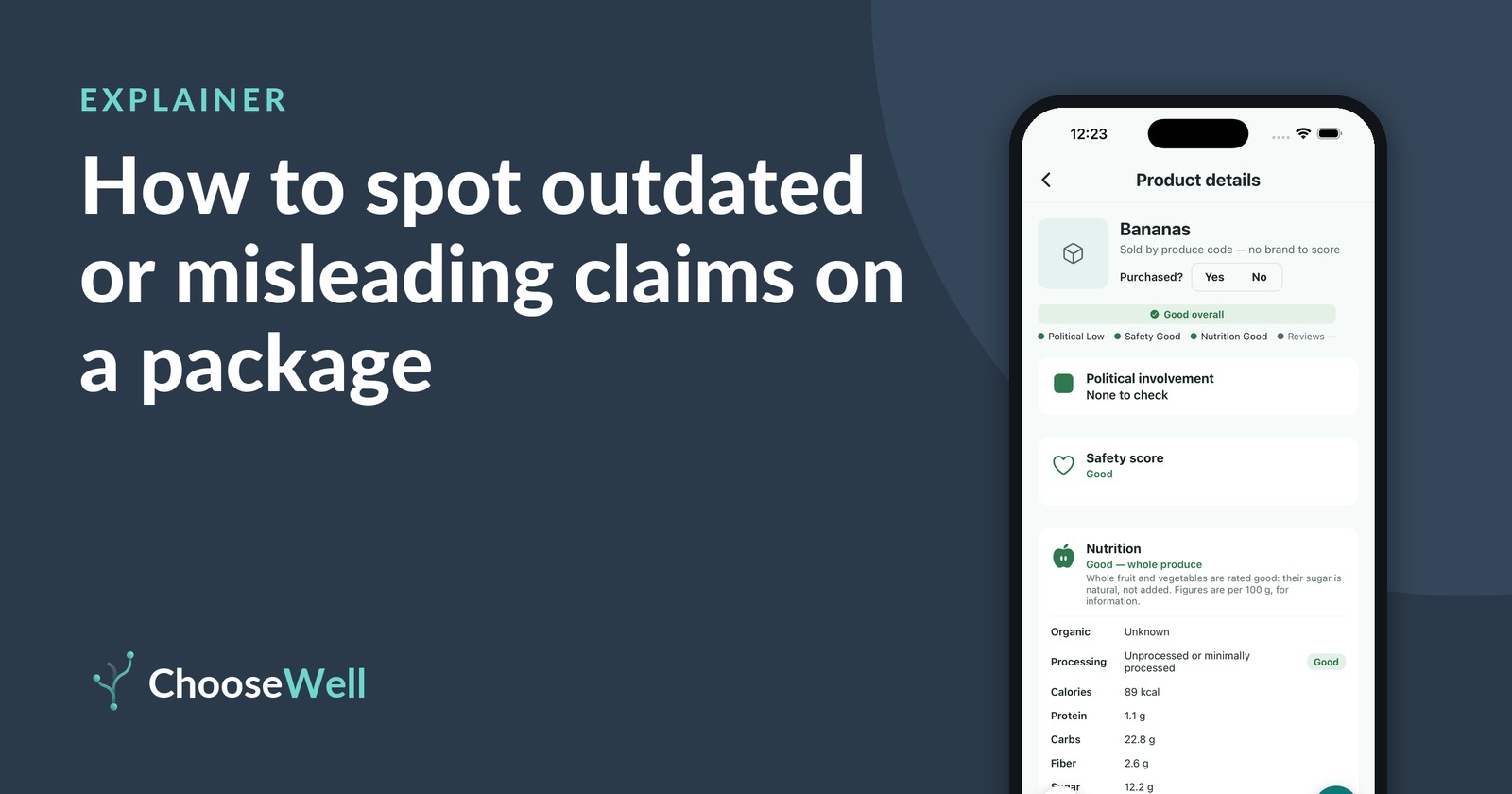
After a scan, the Nutrition card shows the product's own numbers against your targets, and the Safety card shows open recalls and flagged ingredients, each with its source. The front of the box is the claim; those cards are the record.
Check it yourself
Scan any barcode in ChooseWell to see the maker's open recalls, flagged ingredients and political spending, each with its public source. Free to scan, no account.